NeuroCampur AI Global Series
The AI Chip Race
Can Malaysia design the chips that power the future of artificial intelligence?
A conversation with Professor Dr Asrulnizam Abd Manaf on whether Malaysia can become a global creator of AI chip architectures, semiconductor IP and intelligent hardware.

The speaker
Professor Dr Asrulnizam Abd Manaf
Director, Collaborative Microelectronic Design Excellence Centre (CEDEC), Universiti Sains Malaysia
Professor Dr Asrulnizam Abd Manaf leads CEDEC at Universiti Sains Malaysia, the national centre of excellence for integrated circuit design that trains Malaysia's chip designers and works directly with the semiconductor industry in Penang and beyond.
Trained in Japan, he earned his Bachelor and Master of Engineering at Toyohashi University of Technology and his PhD in Engineering at Keio University in 2009. He joined USM that same year and is a Senior Member of the IEEE.
At CEDEC he leads the group working on CMOS based sensing interface circuits, microfluidic MEMS and NEMS, and printable device technology, and he is a leading academic voice behind Penang Silicon Design @5km+, the state's push to grow a home grown IC design hub.
232
Publications
2,200+
Citations
21
h index
28
Postgraduates supervised
Research and the CEDEC lab
Where his work sits today
IC design
Analog and mixed signal circuits on FinFET CMOS and gallium nitride (GaN) technologies.
AI edge devices
Application specific System on Chip (ASIC SoC) design for AI that runs locally, efficiently and securely.
Heterogeneous integration
Chiplet architectures and redistribution layer (RDL) design for advanced packaging.
Lab on a chip
Microfluidic and digital microfluidic biochips, including low cost lab on PCB platforms.
Stretchable and printable electronics
Flexible sensors and devices for wearables and healthcare.
MEMS and NEMS
Micro and nano electromechanical sensing systems with CMOS interface circuitry.
A national IC design centre
CEDEC gives students and engineers hands on access to industry standard EDA tools and independent design projects across the full chip flow.
Penang Silicon Design @5km+
CEDEC showcased its advanced IC design capabilities at the PSD@5km+ inaugural lift off in August 2025, supporting Penang's ambition to move up the value chain.
Talent for the industry
Through IC design clusters, recruitment days and industry programmes, CEDEC builds the hardcore design skills Malaysia's semiconductor sector needs.
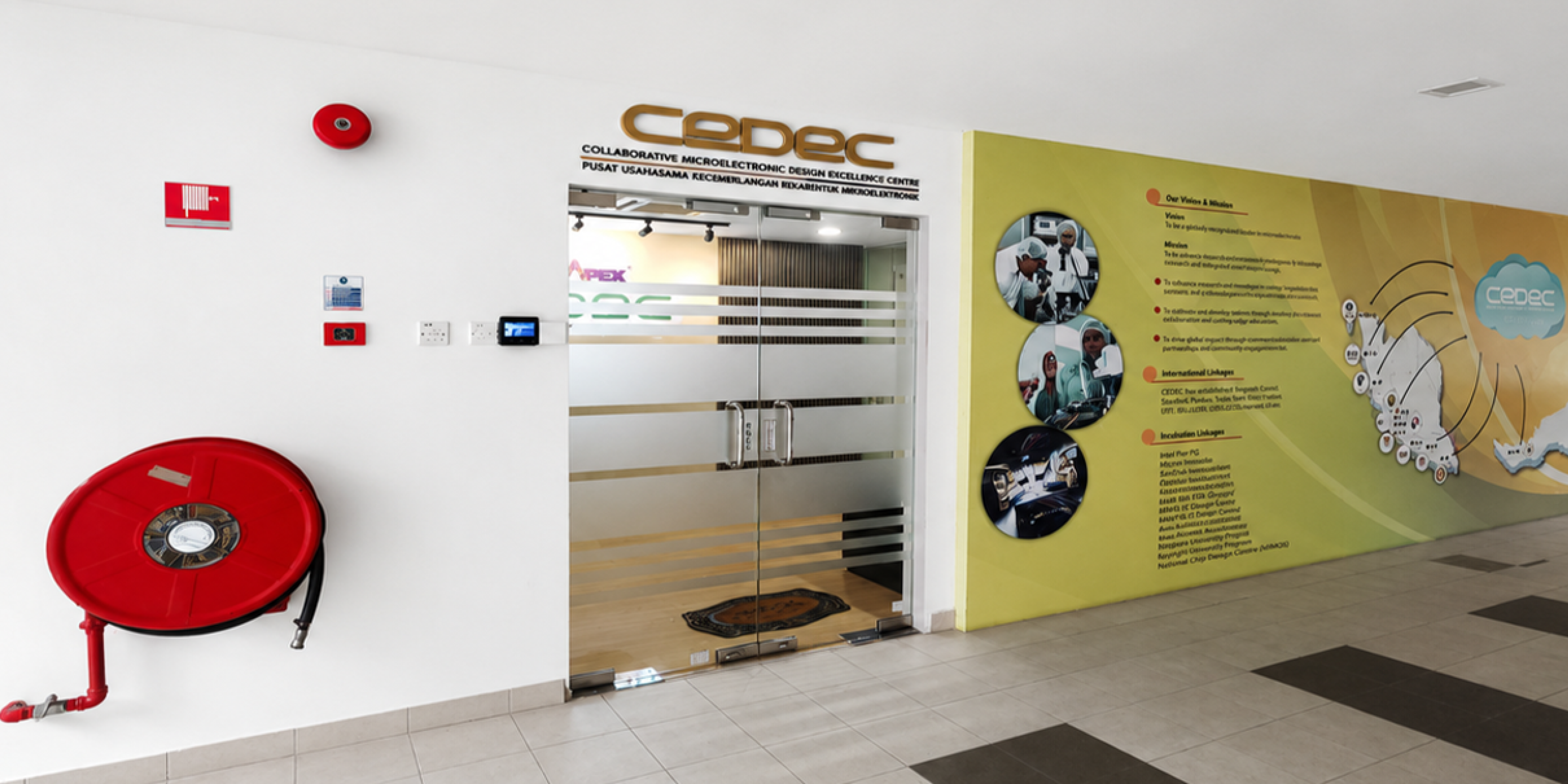
Inside CEDEC
Collaborative Microelectronic Design Excellence Centre
Universiti Sains Malaysia's home for integrated circuit design, where Malaysia's next generation of chip designers is trained.


Programme
Five questions for the conversation
- 01
Can AI design the next generation of AI chips?
How AI is reshaping circuit optimisation, electronic design automation, verification and testing, and whether it can lower the cost and barriers of advanced IC design.
- 02
The rise of edge AI and intelligent chips
Opportunities for Malaysian researchers to build specialised chips for healthcare devices, autonomous systems and industrial sensors.
- 03
Malaysia's semiconductor opportunity
Capturing more value through indigenous AI chip designs, semiconductor IP, advanced packaging and fabless companies.
- 04
From academic research to commercial AI hardware
The obstacles between university innovation and the market, and how to connect researchers, designers, foundries and investors.
- 05
Malaysia and the UK, shaping AI hardware together
Joint research, partnerships and the Cambridge technology ecosystem as a route to competitive semiconductor innovation.
The session closes with his personal vision for Malaysia's place in the global AI semiconductor industry over the next decade, ahead of Akal Budi AI 2027 at Oxford.
Register for the session
Saturday 7 November 2026 · Online · 10:00 UK time / 18:00 Malaysia time · Free to attend
Only registered participants receive the online joining link. No website account is needed.
All queries: aisyah@neurocampur.com